Flying With a Wheelchair or Scooter in Canada: Air Canada, WestJet and Your Parent's Rights
How to book wheelchair assistance on Air Canada, WestJet and other large Canadian airlines for an aging parent: the 48-hour rule, what the airline must do free, flying with a scooter or power chair, travel wheelchairs, and what happens if it's damaged.
By Jonathan Kennedy · Last reviewed October 2026
On this page (7 sections)
To get wheelchair assistance on Air Canada, WestJet or any large Canadian airline, ask for it when you book and at least 48 hours before departure. Under the federal Accessible Transportation for Persons with Disabilities Regulations, a large carrier must then help your parent check in, get through security and reach the gate, transfer to their seat, and carry their own wheelchair or scooter as priority baggage, all at no charge. If the airline damages or loses it, it must provide a temporary replacement and repair or replace it at its own cost.
Maybe your parent wants to see the grandkids in Calgary, or winter somewhere warm, but the airport itself has become the hard part: long walks, lines and stairs. Many families quietly drop the trip. It doesn't have to go that way; airlines handle wheelchair travel every day, and a little planning makes the day calm.
Do this next:
- Call or book online with the airline's accessibility service at least 48 hours ahead, and get the request confirmed in writing.
- Flying with your parent's own power chair or scooter? Have the make, model, weight and battery type ready when you call.
- Need a lighter chair for the trip? Compare wheelchairs, including travel and transport models, or rent one for the holiday.
What must a large Canadian airline do for a traveller in a wheelchair?
The rules apply to large carriers (those carrying 1 million or more passengers a year in each of the two previous years), which includes Air Canada and WestJet, on aircraft with more than 29 passenger seats. On request, the airline must, among other things:
- Help with check-in at the counter.
- Help through security screening.
- Help your parent get to the boarding area, and check on them while they wait if they can't move around on their own.
- Transfer your parent between their own wheelchair and an airline wheelchair, and between the wheelchair and their seat.
- Accept their mobility aid (wheelchair, scooter, walker and more) as priority baggage, and let them keep it until it has to be stowed.
- Take it apart and pack it if needed, then put it back together and return it without delay on arrival.
The airline can't charge for any service the regulations require. Regular baggage fees for other bags can still apply.
Our take: Ask for help all the way to the gate even if your parent can walk short distances. Airports are huge, gates change, and arriving tired at the end of a long concourse is how trips start badly.
How far ahead do you have to ask?
Ask at least 48 hours before departure. With that notice, the airline must provide the service. If you ask later, the airline still has to make a reasonable effort, and some services, like help at check-in, must be provided even on short notice. For anything that needs more preparation, such as taking a power chair apart, earlier is always better.
Can you fly with a power wheelchair or scooter?
Usually, yes. The airline can refuse a mobility aid only for a set of practical reasons, such as the baggage hold door being too small, the aid being too heavy or large for the lift, or it putting the aircraft's safety at risk. Smaller aircraft are where this comes up.
Batteries are the part that needs planning. Give the airline the battery type and specs when you book, bring any written instructions for taking the chair apart, and expect to arrive earlier than usual. Take off anything that can come loose, like the cushion and the joystick cover, and carry them on board.
What happens if the airline damages or loses the wheelchair?
The airline must act without delay and at its own cost: provide a temporary replacement your parent can use, reimburse expenses caused by the damage or loss, and repair the chair or, if repair won't do, replace it or pay its full replacement cost. If a mobility aid isn't returned within 96 hours of arrival, it's treated as lost.
Take photos of the chair before you hand it over, and report any damage at the airport before you leave.
Is a travel wheelchair worth buying?
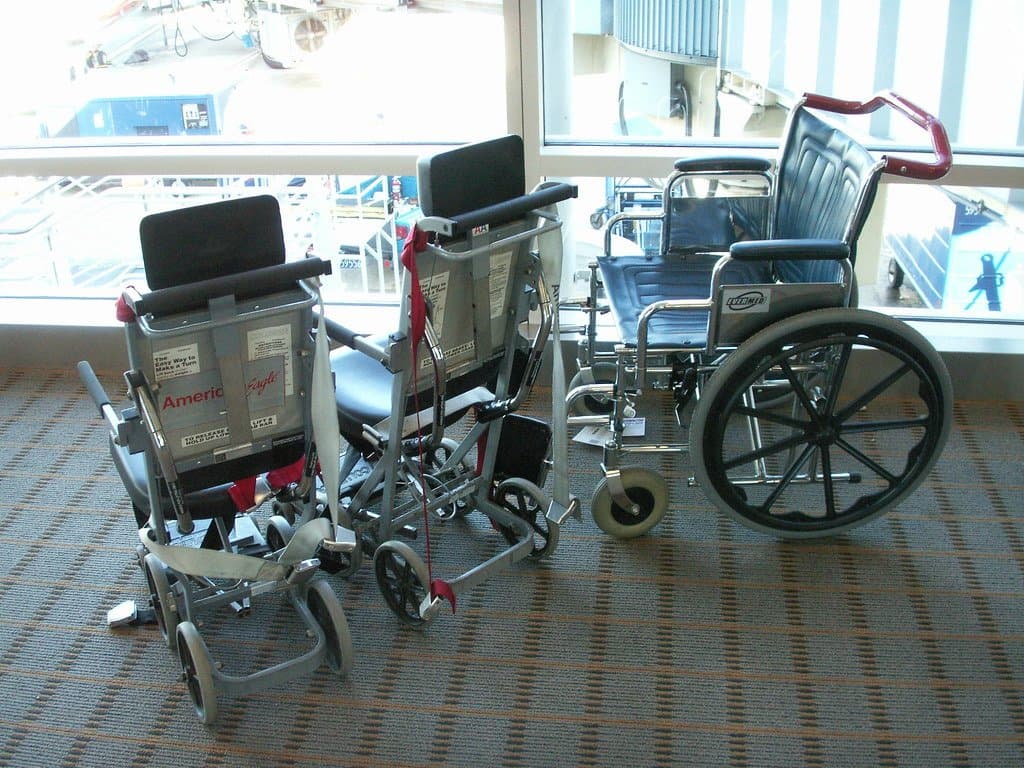
For a parent who flies once or twice a year and normally uses a walker or a heavy chair, a travel wheelchair or lightweight folding wheelchair can be worth it. It's easier to lift into a taxi or rental car and to fold at the hotel. A folding power wheelchair is another option for a parent who can't self-propel but wants independence at the other end.
Does your parent need a second seat for a helper?
On flights within Canada, large carriers must give a free adjacent seat to a support person when a traveller needs one for a disability-related reason (the "one person, one fare" rule). On international flights, the airline must provide the seat but may charge for it. Ask about the approval process when you book, because it's handled separately from wheelchair assistance.
How do you make the travel day easier for your parent?
- Choose a direct flight and a mid-morning departure.
- Pack medications, a change of clothes and any chargers in the carry-on.
- Write the booking reference and assistance request on a card your parent keeps.
- Arrange help at the other end, too: a ride that can take the wheelchair, and someone to meet them at arrivals.
Frequently asked questions
How do I request wheelchair assistance on Air Canada?
Ask for it when you book, or through Air Canada's accessibility service, at least 48 hours before departure. Large Canadian airlines must then help with check-in, security, getting to the gate and boarding, free of charge.
Do airlines charge for wheelchairs or scooters in Canada?
No. Large Canadian airlines must carry a passenger's mobility aid, including wheelchairs and scooters, as priority baggage and can't charge for the services the accessibility regulations require. Regular baggage fees can still apply to other bags.
What happens if an airline damages a wheelchair in Canada?
The airline must provide a temporary replacement without delay, reimburse related expenses, and repair the chair or replace it or pay its full replacement cost. A mobility aid not returned within 96 hours of arrival is treated as lost.
What is a travel wheelchair?
A lightweight wheelchair that folds small for cars, hotels and flights. It suits a parent who walks short distances or normally uses a heavier chair and only needs a portable one on trips.
Can a caregiver fly free with a senior in Canada?
On domestic flights with large Canadian carriers, a support person gets an adjacent seat free when the traveller needs one for a disability-related reason. On international flights, the seat must be provided but can be charged.
Last reviewed October 2026. We keep our guides current as costs, programs, and options change.
Need personal guidance?
Our advisors can help you apply this to your family, free and confidential.