Hoyer Lift vs Sit-to-Stand Lift: Which Patient Lift Is Right for Home?
How to choose between a Hoyer (full-body sling) lift and a sit-to-stand lift for a parent at home in Canada: who each one suits, floor vs ceiling lifts, slings, 2026 prices, and who helps pay.
By Jonathan Kennedy · Last reviewed October 2026
On this page (7 sections)
Choose a sit-to-stand lift if your parent can bear some weight, hold on with their hands and sit up on their own; choose a Hoyer-style full-body sling lift if they can't stand or support themselves at all. Patient lifts for home cost about $700 to $2,000 for a manual hydraulic floor lift, $2,000 to $5,000 for an electric portable lift and $3,500 to $12,000 or more for a ceiling track system in 2026. An occupational therapist should make the call, because the wrong lift is unsafe for both of you.
Maybe you've been lifting Mom from the bed to the chair yourself, and your back is starting to tell you about it. Or a home care worker has said they can't do the transfer safely without equipment. You're not doing anything wrong; you've simply reached the point where a lift protects everyone, and families get through this step every day.
Do this next:
- Book an assessment with an occupational therapist. They'll test the transfer, pick the lift and the sling, and show you how to use it.
- Compare patient lifts, with floor and ceiling options and the brands Canadian dealers install and service.
- If your parent can still help with the move, a smaller transfer aid such as a pole, belt or board may be enough for now.
Hoyer lift or sit-to-stand: how do you tell which one your parent needs?
It comes down to how much your parent can do in the middle of the transfer.
| Sit-to-stand lift | Hoyer-style full-body lift | |
|---|---|---|
| Your parent can bear weight | Some, through the legs | None needed |
| Upper body | Can hold the handles and sit upright | Can't, or tires quickly |
| Typical transfers | Chair to toilet, bed edge to wheelchair, standing for dressing | Bed to chair, bed to commode, off the floor after a fall |
| Sling | A band around the back, under the arms | A full sling under the body, often with head support |
| What it keeps | Standing and leg strength | Safety when standing isn't possible |
People often say "Hoyer" for any patient lift, the same way they say Kleenex for tissue. Hoyer is a brand (now part of Joerns Healthcare); the type is a full-body sling lift.
Our take: If your parent can still stand for a moment, start with a sit-to-stand. Using their own legs every day keeps strength longer. Switch to a full-body lift the day the therapist says standing is no longer safe, not before.
Floor lift or ceiling lift?
A floor lift rolls on wheels and goes from room to room. It needs clearance under the bed for its legs and room to turn, which can be tight in older homes and on carpet.
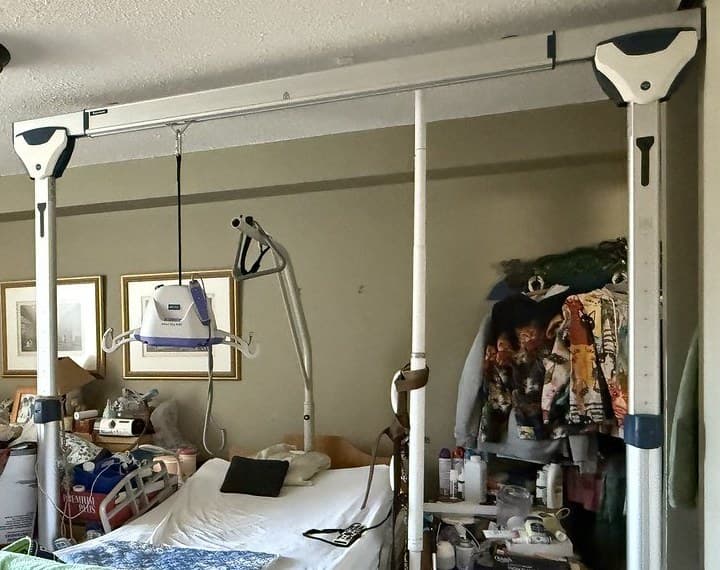
A ceiling lift runs on a track. It takes no floor space and is the easiest on a caregiver, which is why families doing many transfers a day often choose it. A permanent track is installed into the ceiling, while a freestanding frame (like the one in the photo at the top) sets up over the bed without construction.
| Lift type | Typical cost (2026) | Best for |
|---|---|---|
| Manual hydraulic floor lift | $700 to $2,000 | Occasional transfers, a strong caregiver |
| Electric portable floor lift | $2,000 to $5,000 | Daily transfers, moving between rooms |
| Ceiling track system | $3,500 to $12,000+ | Many transfers a day, tight rooms, protecting caregivers' backs |
Prices are illustrative installed or supplied prices in CAD. Track length, weight capacity and the number of slings move the total.
Is a ceiling lift worth the higher price?
For a parent who needs several transfers a day, and who you hope to keep at home for years, usually yes. It's faster, smoother and kinder on whoever does the lifting, family or paid caregivers. It also makes every visit easier if you bring in private home care, because the caregiver isn't wrestling a floor lift around the bed.
Which brands do Canadian dealers carry?
| Brand | Known for | Weight capacity (typical) |
|---|---|---|
| Invacare | Floor and stand-assist lifts, strong parts support | Up to 450 lb |
| Hoyer (Joerns) | The widely serviced standard full-body lift | Up to 500 lb |
| Drive Medical | Lower-cost manual and electric floor lifts | Up to 450 lb |
| Handicare | Professionally fitted ceiling track systems | 450 to 625 lb (ceiling lift) |
| Guldmann | Clinical-grade ceiling lifts used in care homes and hospitals | Up to 880 lb (GH3) |
What should you check before you buy?
- The assessment: which lift, which sling and which size, in writing.
- Training: who shows every caregiver how to use it, including weekend and night staff.
- Slings: you'll want at least two, so one can be washed.
- Service: battery replacement, yearly inspection, and how fast they come if it stops working.
- Space: measure door widths, the bathroom and the room around the bed.
Who helps pay for a patient lift in Canada?
- Ontario: the Assistive Devices Program's mobility aids list doesn't include patient lifts, so ask the ADP office to confirm before you count on it.
- Tax: the CRA lists power-operated lift equipment that helps a person with a disability reach different areas of a building, and bathroom aids for getting in and out of a tub or on and off a toilet, as eligible medical expenses with a prescription. Ask your accountant how your lift fits.
- Renovation credits: an installed ceiling track may count toward home accessibility credits and grants. See our home accessibility grants page.
- Veterans and insurance: Veterans Affairs Canada and many private health plans cover lifts with a prescription and a quote.
- Short term: if your parent is recovering, renting first can make sense. Our medical equipment rental guide covers how.
How do you bring a lift into the home without upsetting your parent?
Some parents feel a lift means they've "given up". Explain that it's to protect the people helping them, and that it keeps them at home. Let them try it with the therapist there, go slowly, and keep talking through every step of the transfer.
Frequently asked questions
What is the difference between a Hoyer lift and a sit-to-stand lift?
A Hoyer-style lift lifts the whole body in a sling and suits someone who can't stand or support themselves. A sit-to-stand lift helps someone who can bear some weight and hold on rise from sitting to standing, using a band behind the back.
How much does a patient lift cost in Canada?
About $700 to $2,000 for a manual hydraulic floor lift, $2,000 to $5,000 for an electric portable lift and $3,500 to $12,000 or more for a ceiling track system in 2026, depending on capacity, slings and track length.
Can one caregiver use a patient lift alone?
Many electric floor and ceiling lifts are designed for one trained caregiver. Some heavier or more complex transfers need two people, so follow the occupational therapist's assessment and get every caregiver trained.
Does Ontario's ADP pay for patient lifts?
Patient lifts aren't on ADP's list of covered mobility aids, so confirm with ADP before counting on it. With a prescription, some lift equipment is an eligible medical expense on the tax return.
Are portable patient lifts good for home use?
Yes, for occasional or room-to-room transfers in homes with enough space under the bed and to turn. For many transfers a day or tight rooms, a ceiling or freestanding track lift is usually easier.
Last reviewed October 2026. We keep our guides current as costs, programs, and options change.
Need personal guidance?
Our advisors can help you apply this to your family, free and confidential.